The battleship HMS Ocean—a British warship that sank off the Dardanelles
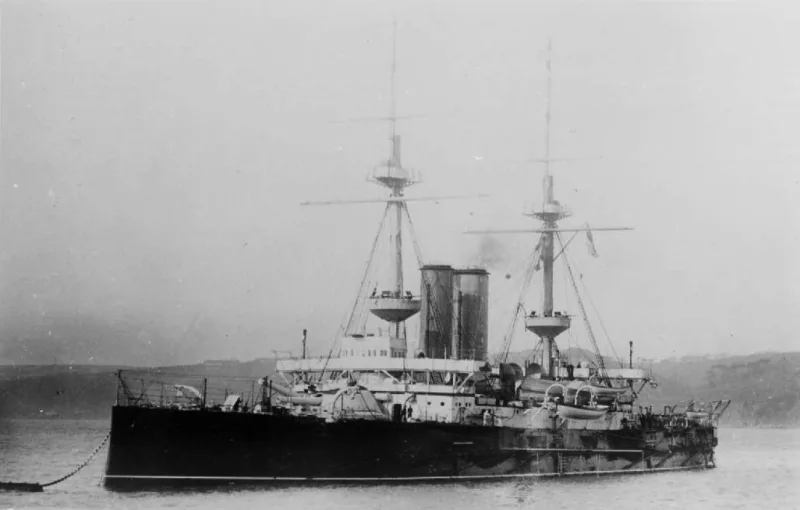
The battleship HMS Ocean is neither a stone fortress nor an ancient colonnade, but a heavy British dreadnought-class battleship that lies permanently on the seabed of Morto Bay at the entrance to the Dardanelles. On March 18, 1915, on the most terrible day for the Allied fleet at Gallipoli, the ship struck a mine and sank off Cape Eskihisar, where the Gallipoli Memorial to the Fallen stands today. The battleship HMS Ocean was built in Devonport in just two and a half years and launched in July 1898; fifteen years later, its 12-inch guns thundered over the Shatt al-Arab, the Suez Canal, and the strait that became its grave. This is the story of a ship whose sinking made the Turkish coast near Erenköy one of the most dramatic chapters in 20th-century naval history.
History and Origin of the Battleship HMS Ocean
The ship belonged to the Canopus class—six battleships designed by the Admiralty specifically for the Far East. At the turn of the 19th and 20th centuries, Japan was rapidly building its own fleet, and London needed a class of ships capable of reaching Hong Kong under their own power while matching the firepower of the earlier “Majestics.” The designers sacrificed armor thickness but, for the first time in British practice, installed Krupp cemented steel and Belville water-tube boilers—a compromise that yielded a speed increase of two full knots.
The keel was laid on December 15, 1897, at the Devonport shipyard; the Ocean became the first large battleship built there. The launch on July 5, 1898, took place in the presence of the Lords of the Admiralty, and the ship was christened by Princess Louise, Marchioness of Lorn. The battleship entered service on February 20, 1900, under the command of Captain Ashton Curzon-Howe, and by March had already relieved the HMS Hood in Gibraltar, joining the Mediterranean Fleet.
In January 1901, the ship was transferred to the China Station: the Boxer Rebellion was raging in the Far East. In October 1902, the Ocean reached Port Lazarev in Korea, was caught in a typhoon, and remained in dry dock for repairs until 1903. Following the conclusion of the Anglo-Japanese Alliance in 1902, the Admiralty reduced its presence in China: On June 7, 1905, the battleship sailed from Hong Kong alongside her sister ship, the Centurion; in Singapore, they were joined by the similarly classed Albion and Vengeance, and on August 2, all four ships dropped anchor in Plymouth.
What followed was the usual cycle of the era: reserve duty at Chatham, return to active service on January 2, 1906, service in the Channel Fleet, repairs, the Mediterranean, the Malta dockyard, and the installation of fire-control equipment. By 1910, the Ocean was already considered obsolete and was transferred to the 4th Division of the Home Fleet; on the eve of the war, she was based at Pembroke Dock as a ship of the Third Fleet.
With the outbreak of World War I on August 14, 1914, the ship joined the 8th Battle Squadron of the Channel Fleet. On August 21, she was sent to Queenstown (now Cow) in Ireland—to guard the approaches to the Atlantic and support the cruiser squadron. In September, orders followed one after another: first to relieve the sister ship Albion near the Cape Verde Islands, then to Madeira, and then to the Azores. The threat posed by Admiral von Spee’s German East Asia Squadron and the independently operating cruiser "Königsberg" forced the Admiralty to redirect the "Ocean" to the East India Station, where convoys carrying Indian troops bound for Mesopotamia and Egypt were awaiting it. The armored cruiser "Minerva" joined the battleship, and by the fall of 1914, the "Ocean," serving as the squadron's flagship in the Persian Gulf, was already supporting amphibious operations in the Shatt al-Arab delta.
Architecture and What to See
The ship itself, of course, cannot be explored—it lies on the seabed at a depth of about forty meters and is considered a military burial site. But visualizing its “architecture” is helpful for understanding the scale of the tragedy at the Dardanelles. And most importantly—a whole landscape of remembrance has been preserved on the coast near Edjeabat, physically linked to the Ocean’s final day.
Hull and Main Caliber
The ship’s length along the hull was 128.47 meters, its width 23 meters, and its draft nearly 8 meters. Full displacement was close to 14,300 long tons. The crew consisted of 682 officers and sailors. The main armament consisted of four 12-inch guns with a 35-caliber barrel length, mounted in two twin-gun turrets at the bow and stern on circular barbettes: this design allowed the guns to be loaded in any turret position, but only at a fixed elevation angle.
Secondary armament: twelve 152-millimeter guns with a length of 40 calibers in casemates along the sides. Ten 12-pounder and six 3-pounder guns were added for anti-torpedo boat defense. Four 18-inch torpedo tubes were concealed below the waterline. The main belt was made of Krupp steel—152 mm (instead of 229 mm on the “Majestics”), the turrets—254 mm, the barbettes—305 mm, the conning tower—305 mm, and two armored decks, 25 mm and 51 mm thick.
Propulsion
Two triple-expansion steam engines with three cylinders were supplied with steam from twenty Belville water-tube boilers—a revolutionary solution for the time. This made it possible to abandon the transverse arrangement of the funnels and, for the first time, install the funnels longitudinally, as was subsequently done on all modern ships. The design speed of 18 knots at 13,500 indicated horsepower was considered excellent for a battleship of that generation.
Final Battle and Place of Sinking
On March 18, 1915, Admiral John de Robeck led a combined Anglo-French squadron of sixteen battleships toward the Dardanelles—the largest attempt to break through the narrow strait in history. The Ocean sailed in the second line alongside the Majestic and provided support for the leading trio—the Queen Elizabeth, the Agamemnon, and the Lord Nelson. Around 2:00 p.m., the French ship Bouvet struck a mine laid by the Nusret and sank in two minutes, claiming 600 lives. A few hours later, the Irresistible struck the same minefield; the Ocean received orders to rescue its crew and attempt to tow the ship. Under heavy fire from the European shore, the towing operation failed, and as it withdrew, the Ocean itself struck a mine off Cape Eskihisar. The destroyers managed to evacuate the crew, and the abandoned ship slowly sank to the bottom of Morto Bay at coordinates approximately 40°01′ N, 26°18′ E.
What to see on the shore today
A few kilometers west of the site of the sinking stands the 41.7-meter-tall Çanakkale Şehitler Abidesi (Çanakkale Martyrs’ Memorial)—Turkey’s main national monument dedicated to the defenders of the Dardanelles. From its observation deck, Morto Bay is clearly visible, and on a clear day, even the island of Gökçeada. Nearby lies the Simena Park-Museum, featuring restored trenches, casemates, and a sculpture of Corporal Seyt, who single-handedly lifted a 276-kilogram shell during the battle on March 18, 1915. Nearby are Rumeli Mecidiye Fort, Sedülbahir Fort, and memorial cemeteries—British, French, Australian-New Zealand, and Turkish. Together, these form the Gallipoli Peninsula National Historical Park, open 24 hours a day with free admission to most sites.
Interesting Facts and Legends
- The "Ocean" became the first large battleship built at the government-owned Devonport shipyard, thereby proving the ability of state-run docks to compete with private giants like Vickers and Armstrong.
- In November 1914, a landing party of 600 men from the *Ocean* entered the El Fao fortress at the mouth of the Shatt al-Arab and captured it without a single shot being fired in resistance—this episode served as the prologue to the entire Mesopotamian campaign.
- On the morning of March 18, 1915, the Ocean attempted to tow the battleship Irresistible, which had already struck a mine, but heavy fire from the batteries at Erenköy forced the rescue attempt to be abandoned; the ship managed to evacuate part of its crew before striking a mine itself.
- Turkish historiography particularly emphasizes the role of the minelayer Nusret, which secretly laid 26 mines in the Erenköy Bay area on the night of March 8—it was this very line that sank the Ocean, the Irresistible, and the French ship Bouvet. A replica of the “Nusret” stands at the Çanakkale Memorial as a monument.
- According to the Turkish account, even before the ship struck a mine, the Ocean’s steering mechanism had been damaged by a shell fired by Corporal Seyt from Rumeli Medjidiye Fort—films, school textbooks, and poems are dedicated to this moment; for millions of Turks, March 18 remains to this day Victory and Martyrs’ Day at Çanakkale.
How to get there
The closest access point to the site of the sinking is the village of Seddülbahir and Cape Eskihisarli on the European shore of the strait, in the Çanakkale province, Eceabat district. The most convenient route for Russian-speaking travelers is to fly to Istanbul (IST or SAW Airport), take a bus operated by Metro Turizm, Truva, or Kamil Koç to the Çanakkale bus station (about 5–6 hours via Tekirdağ and the Lapseki–Çanakkale ferry crossing) and from there—by ferry across the strait to Eceabat (15–20 minutes, runs every hour). From Edgebat to the memorial and Seddu’l-Bahir, it is 35 km along the D550 road—about 40 minutes by minibus (dolmuş) or taxi.
An alternative is a domestic flight with Turkish Airlines or AnadoluJet to Çanakkale Airport (CKZ), followed by a city bus or taxi to the ferry. For drivers, it is more convenient to take the 1915 Çanakkale Bridge, which opened in 2022: the crossing takes 6 minutes instead of an hour by ferry. The drive from the bridge to the Şehitler Anıtı memorial takes about 25 minutes.
Tips for travelers
The best time to visit is April–May and September–October: the air is warm, the sea breeze is moderate, and the crowds of school field trips are still small. On March 18, thousands of Turks flock to the Gallipoli Peninsula—it is the Day of Remembrance for the Fallen at Çanakkale, with solemn ceremonies at the memorial and fireworks; the spectacle is impressive, but you need to book accommodation in Edgebat and Çanakkale a month and a half in advance. In summer, especially in July and August, it can be sweltering, and there is almost no shade at the former battle sites—be sure to bring water, a hat, and sunscreen.
Set aside a full day—or better yet, two days with an overnight stay in Edgebat or right at the national park’s campgrounds—to explore the entire complex of battlefields (Şehitler Abidesi, Sedülbahir Fort, Cape Gelles, Anzac Cove, Lone Pine, Rumeli Mecidiye Fort). There is free parking at the entrance to the museum complex, and an audio guide in Russian is available (to be picked up at the information center with a valid ID as a deposit). Diving to the hull of the "Ocean" and other sunken ships is prohibited without special permission from the Turkish military and the Ministry of Culture—this is a protected military burial site.
Combine your visit with a tour of ancient Troy, 30 km south of Çanakkale (a UNESCO site), and the city of Assos on the Aegean coast; together with the Gallipoli Peninsula, they form a compelling two- to three-day itinerary through “classic” northwestern Turkey. As for the region’s cuisine, be sure to try Çanakkale’s “peynirli pide,” fresh grilled sardines, and local olive oil from Ezine. And one last thing: the battleship HMS Ocean is not only a British warship lying at the bottom of the Dardanelles, but also a part of the shared memory of the United Kingdom, Turkey, France, and the Commonwealth nations; stand for a moment at the obelisk in Şehitler Abidesi and gaze out at the strait—it was here, in March 1915, that a page in naval history was turned.